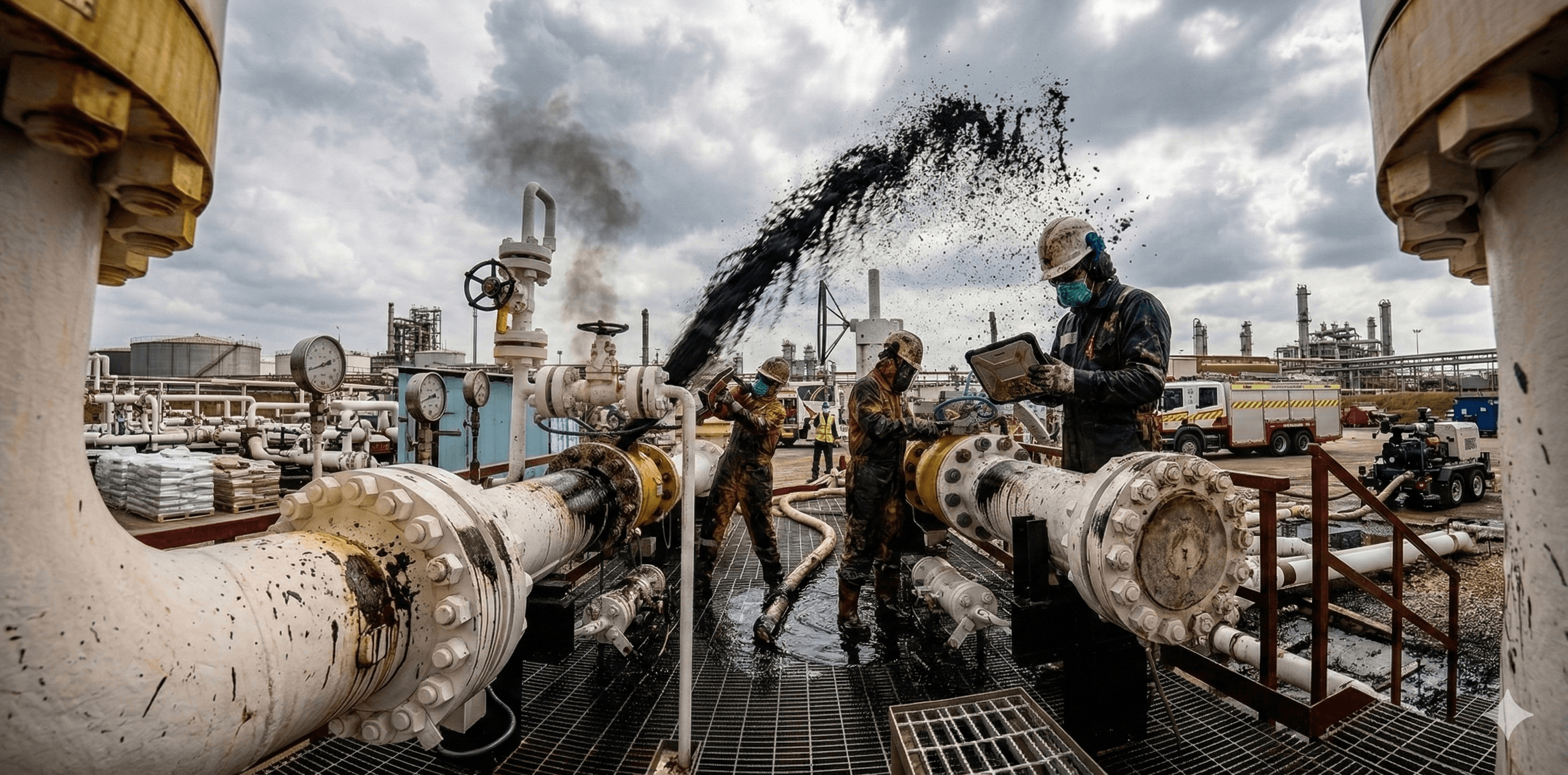

Pipeline Emergency Response
Practical training for emergency response teams
An intensive practical course in pipeline leak containment and emergency response
Pipeline accidents pose enormous risks: hazardous substance leaks, fires, environmental damage and production stoppages. The lives of people and the scale of consequences depend on the speed and correctness of the first responding teams.
The course prepares participants for actions in a real emergency, using realistic pressurised pipeline training simulators.
The programme includes team coordination drills, selecting the correct isolation and repair methods, and using specialised equipment.

Who the course is for

Enterprise emergency response teams

Fire and gas rescue units
Emergency repair crew members

Process plant operators

Industrial safety and occupational health specialists
Non-professional emergency response team members
Training objectives
During the course participants develop practical skills in:
- Assessing the situation and reconnaissance of the incident site.
- Selecting and using appropriate personal protective equipment.
- Isolating the damaged pipeline section.
- Installing clamps, wraps and plugs under pressure.
- Quality control of completed repair work.
Training format
Duration: 2–3 days (depending on participants' level of preparation).
Format: 30% theory / 70% practical work on the training ground.
Assessment: Practical scenario-based examination.

Interactive theory
Equipment demonstration

Simulator practice

Final exercises
Key course topics
Hazards in pipeline emergencies
- • Properties of hazardous substances.
- • Physics of gas and liquid discharge processes.
- • Gas cloud and fire zones.
- • Risk factors for personnel.
Personal protective equipment and breathing apparatus
- • Selecting respiratory and skin protection.
- • Donning and inspection procedures.
- • Monitoring time in breathing apparatus.
Specialised equipment
Equipment for leak containment:
- • pneumatic clamps and patches;
- • mechanical clamps and grips;
- • sealing compounds and tapes.
- • Intrinsically safe tools.
Practical scenarios
On the second day of the course participants complete realistic training scenarios:
Scenario 1

Gas leak on an above-ground pipeline
— containment using a pneumatic clamp; — setting up the work zone.
Scenario 2

Oil pipeline rupture with product spill
— installing a clamp; — using absorbents and collecting the product.
Scenario 3

Leak at a flanged joint under pressure
— fitting a special enclosure; — pressure monitoring and leak-tightness verification.
Skills participants will gain
On completing the course participants will be able to:
- • rapidly assess the situation in pipeline emergencies;
- • select containment methods;
- • work safely in breathing apparatus;
- • operate effectively as a team.
Result for the organisation
After completing the course, the organisation's personnel will be able to:
- • reduce emergency response times;
- • minimise damage from leaks;
- • improve the safety of repair operations.