
On-site Emergency Commander (RLAM)
A practical training course for on-site emergency response commanders
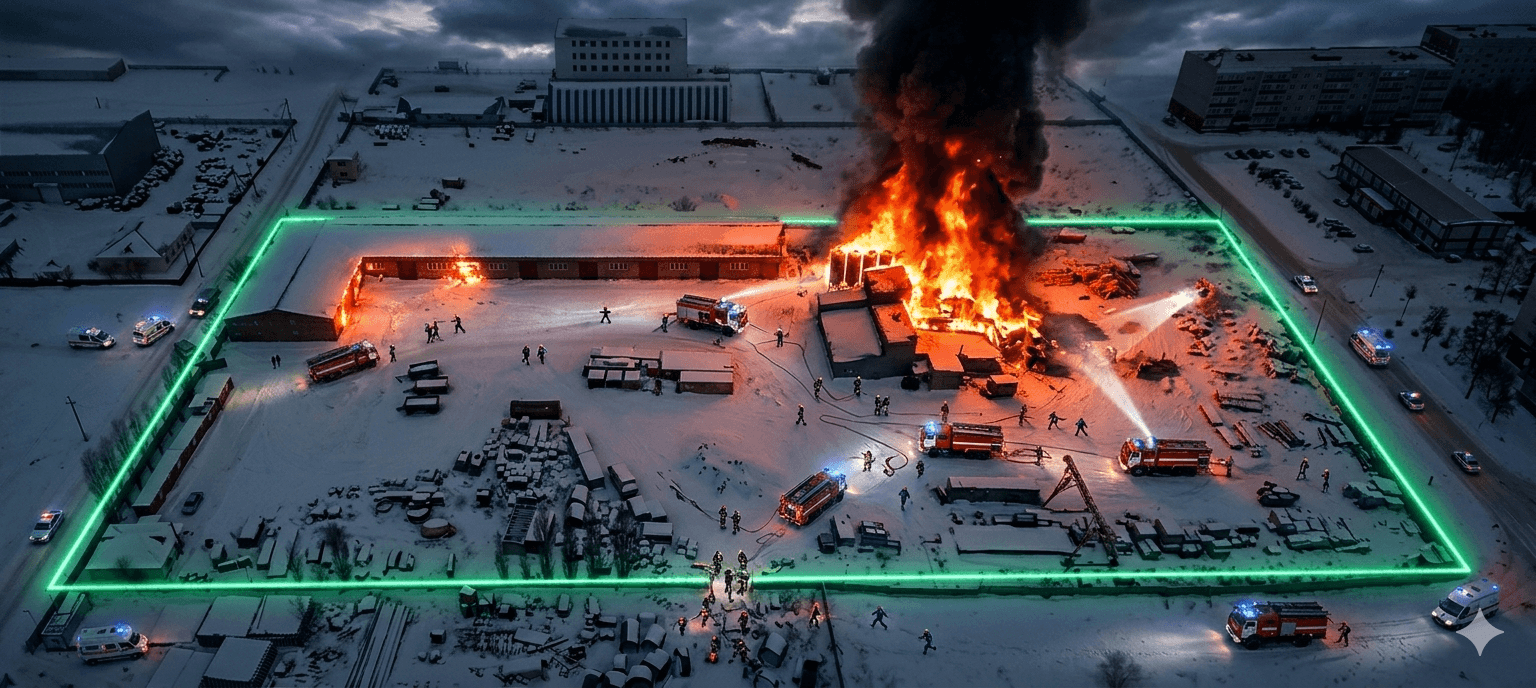
An emergency is always chaos, uncertainty, time pressure and enormous risk. The lives of people and the scale of consequences depend on how the on-site commander acts in the first minutes.
The On-site Emergency Commander (RLAM) course has been developed on the basis of best international practices (UK Fire & Rescue, Incident Command System, OPITO) to prepare specialists for managing emergency situations.
This is not simply lectures about 'what to do' — it is an intensive training programme where participants are immersed in realistic emergency scenarios, make complex decisions under pressure and bear responsibility for the outcome.
Who the course is for
Particularly relevant for enterprises in the oil & gas, petrochemical, energy and mining sectors:

Duty shift supervisors (DSS / RLAM)

Workshop / unit managers

Plant operators

Production engineers

Production section managers

Industrial safety, OHS and environmental specialists

Emergency response team members
What the course teaches
During training participants master response algorithms in the following areas:

Situational awareness
Rapid assessment of the situation, recognising critical factors.

Decision-making under pressure
Applying structured decision algorithms (e.g. FOR-DEC, DECIDE) under stress.

Establishing a Forward Command Post (FCP)
Selecting a safe location, deploying the Forward Command Post.
Resource management
Setting priorities, assigning tasks, monitoring their completion.

Escalation control and containment
Taking measures to prevent the incident from developing, protecting critical zones.

Communication and reporting to command
Delivering clear, structured information (SITREP, METHANE).

Teamwork and leadership
Managing panic, building an effective on-site response team.

Handover of command
Correct and complete transfer of command to arriving professional responders.
Training format
Duration: 3 days

Days 1–2 — theory and tabletop preparation
- • Role and responsibilities of the on-site commander.
- • Legislation and local procedures.
- • Psychology of human behaviour in emergencies.
- • Communication and coordination (SITREP reporting).
- • On-site risk assessment tools (Dynamic Risk Assessment).
Practising inputs on 3D models and plans, independent decision-making and situation management.

Day 3 — practical scenarios
Field exercises using real equipment, fire, smoke and simulated hazardous substance leaks.
Scenarios include:
- Fire at a process plant;
- Toxic gas leak with casualties;
- Hazardous chemical spill.
Commander's tasks in scenarios:
- • conduct a situation assessment;
- • call for assistance and organise evacuation;
- • assign tasks to the team and hand over command.
Horizon's unique methodology

The course uses a Training Under Stress approach — the most important condition for building automatic responses in critical situations.
Simulated conditions include:
- • information scarcity and conflicting information;
- • time pressure and sudden changes in situation (escalation);
- • errors or panic among team members;
- • noise, poor visibility and other distracting factors.
This enables participants to experience real-world pressure and learn to manage it.

Competence assessment
At the end of the course a comprehensive knowledge and skills assessment is conducted.
Theory test:
- ICS fundamentals;
- risk assessment;
- communication protocols;
- understanding of evacuation procedures.
Practical examination:
- • independently commanding a team in a simulated emergency;
- • ability to make correct decisions under stress;
- • correct transfer of information and command.
Each participant receives individual feedback and recommendations.

What participants receive
Internationally recognised skills:
- • confidence in their actions during a real emergency;
- • status of on-site emergency commander (RLAM);
- • certificate of successful completion.

Result for the organisation
A ready on-site commander capable of:
- • quickly taking control of the situation and preventing escalation;
- • reducing the risk of personnel injuries;
- • minimising financial and environmental losses as well as reputational damage.
This is a direct investment in enterprise safety and reduction of material consequences in emergencies.